
Best Email Security Solutions Compared 2026
Check Point, Proofpoint, Mimecast, and Microsoft/Google’s native tools take four different approaches to email security, and independent testing puts API-based protection like Check Point Workspace Security Email far ahead of legacy secure email gateways on catch rate. This guide compares all four on deployment, phishing defence, zero-day protection, DLP, and collaboration app coverage.
Most organisations now run email through Microsoft 365 or Google Workspace, which changes what effective email security actually requires.
The Need for Email Security
Email is one of the most common attack vectors for malware delivery, data exfiltration, and other cyber threats. Email security is a vital component of an enterprise cybersecurity strategy. When email was on-premises, Secure Email Gateways (SEG) made sense, and efficiently and effectively protected corporate email. However, due to the “new normal”, email moved to the cloud at an accelerated rate.
The global email security market was valued at $5.46 billion in 2025 and is projected to reach $6.06 billion in 2026, growing at a CAGR of 11.5% through 2034.
How to Choose an Email Security Company?
For an email security solution to identify and block email-based threats, emails must be routed through the email gateway. This creates challenges for legacy email gateway vendors that designed their solutions with on-prem email servers in mind. In contrast, other solutions are designed for cloud-based email and distributed enterprise.
One of the primary differences between legacy on-prem and cloud-based email solutions is how they direct traffic to the email gateway. The two main approaches are via MX records and application programming interfaces (APIs).
The MX Record Approach
An MX record is part of the DNS record associated with a particular domain. The purpose of the MX record is to identify the IP address of the domain’s email server or mail transfer agent, enabling inbound emails to be routed to that server.
When deploying a legacy SEG, an organization must change its MX records to point to the IP address of that gateway. This enables emails to be routed through the gateway but has significant downsides, including:
- Complexity and Disruption: An MX record approach to email routing requires reconfiguration of an organization’s DNS records and makes significant changes to email routes. This is a very invasive and disruptive approach to deploying a security solution.
- Open Source Intelligence (OSINT): DNS records are designed to be public knowledge, enabling anyone to send an email to a domain. Updating an MX record publicizes the email security solution that an organization uses. This allows attackers to customize their attacks to exploit any known flaws or limitations in the email security solution.
- Limited Visibility: Modifying MX records only reroutes incoming email from outside the domain, meaning that an SEG is blind to internal email traffic. Since internal threats make up 35% of attacks, this leaves an organization exposed to over a third of attacks.
API-Based Solution
SEGs need to rewrite MX records because they lack the ability to directly integrate with email solutions. As a result, they need to reroute email to pass through them on the way to the email solution to provide security.
However, many modern email solutions expose APIs designed to allow a third-party service provider to query and manage a user’s delivered email. This provides the ability to implement email security within the corporate email platform rather than as a standalone solution reliant on intercepting emails en route.
How Does API Replace MX Records?
Some cloud-based email providers offer API access to emails within an account. For example, Microsoft 365 includes the Microsoft Graph API, which allows a third-party service to query the emails delivered to the customer. This API can be set up quickly and easily via OAuth authentication.
Using Microsoft Graph API and similar API-based solutions, it is possible for a third-party provider to offer the following services:
- Anti Spam
- Anti Malware
- Anti Phishing
- URL Filtering
An email security solution that uses API-based integration can be far more effective than an MX record-based approach. For example, Check Point Email Security is 44x more effective at keeping phishing emails from reaching a user’s inbox than legacy email gateways using MX record approaches.
Email Security Vendors Compared
Check Point, Proofpoint, Mimecast, and Microsoft and Google’s native tools take different approaches to email security, with very different results.
Check Point’s API-based email security caught 44x more phishing emails reaching the inbox than legacy gateway vendors including Proofpoint, Mimecast, and Barracuda, and 93x more than Microsoft’s built-in protection, in Check Point’s own testing.
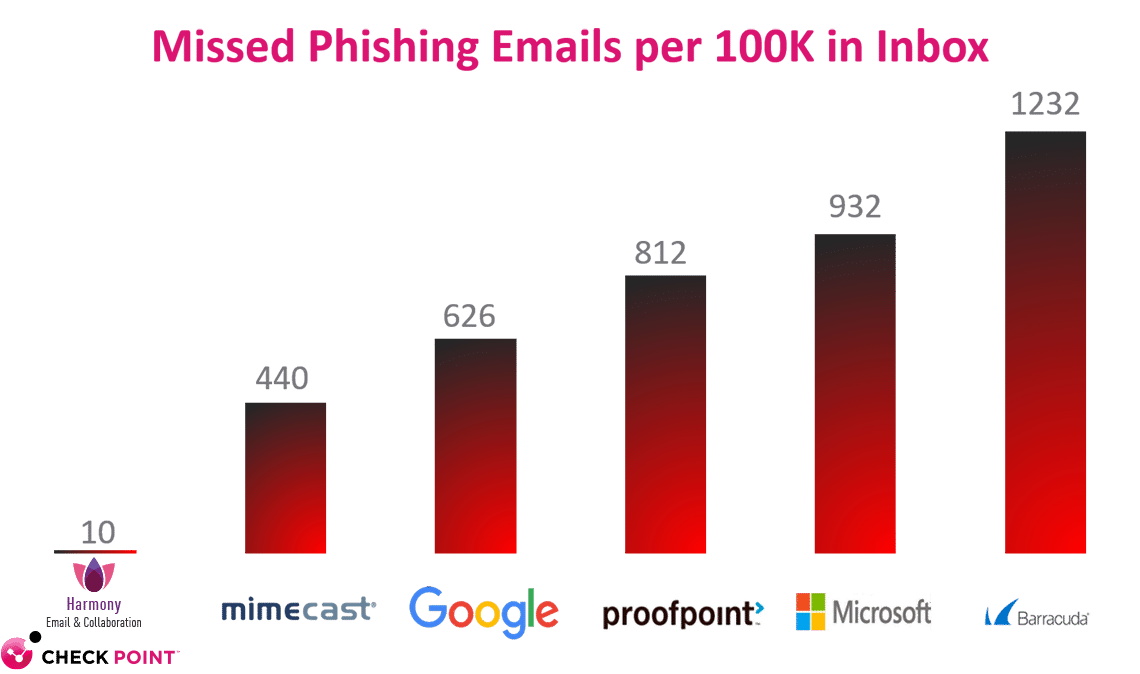
44x more effective than legacy gateway approaches like Proofpoint, Mimecast, and Barracuda
93x more effective than Microsoft

Check Point
Check Point Email Security protects Microsoft 365, Google Workspace, Slack, and Teams from a single platform. It differs from the other vendors on this page in four ways:
- Advanced email security: blocks phishing, malware, and ransomware across inbound, outbound, and internal email in real time.
- Data loss prevention: identifies and blocks sensitive data leaving the organisation through email and connected collaboration apps.
- Account takeover protection: detects and blocks compromised-account activity before it spreads.
- API-native architecture: the first email security platform to combine API-based integration with machine learning and AI detection.

Proofpoint Essentials
Proofpoint Essentials is Proofpoint’s basic email security offering, which includes support for cloud-based email platforms such as Microsoft 365. Some limitations of Proofpoint Essentials include:
- MX-Based Routing: Proofpoint Essentials customers must change their MX DNS record to point to their email gateway.
- No Sandbox: Sandboxed evaluation is essential to identifying novel malware within email attachments.
- No Content Disarm and Reconstruction (CDR): CDR dissects a file, excises malicious content, and rebuilds it before sending the sanitized file on to the recipient. Without CDR, Proofpoint Essentials users must wait to receive clean files.
- Email-Only Protection: Proofpoint Essentials requires a separate cloud application security broker (CASB) solution to protect SaaS applications. This requires additional cost and overhead.
- Single Line of Defense: Deploying Proofpoint Essentials requires disabling security features built into Microsoft 365, such as spam filtering. This increases the probability that malicious emails will reach users’ inboxes.
- Incomplete Protection: Proofpoint’s URL protection is vulnerable to bypass by malformed URLs. This allows emails pointing to phishing pages to reach users’ inboxes.

Mimecast M2
Mimecast M2 is an email security solution based on traditional gateway approaches to email security. Some of the shortcomings of Mimecast M2 email security include:
- MX-Based Routing: Mimecast M2 forces customers to modify their MX records to direct email through the secure email gateway.
- Anomaly-Based Detection: Mimecast M2 relies on basic anomaly detection to analyze email contents with no dynamic analysis.
- Limited Sandboxing: Mimecast M2’s sandbox is incapable of catching advanced evasion techniques.
- Static Social Engineering Protection: Mimecast M2 only uses static dictionary matching to identify impersonation in phishing emails.
- MTA-Based Deployment: Email protection can only be deployed using MTA.
- Manual DLP Definitions: Administrators must manually define data types for DLP.


Native Vendors Security (Microsoft and Google)
Microsoft Exchange Online Protection (EOP) is included with all Microsoft 365 packages, with Defender for Office 365 Plan 1 and Plan 2 available as paid add-ons, such as:
- Less Comprehensive Coverage: Microsoft and Google specialize in cloud email hosting, not email security. As a result, their email security solutions are less comprehensive than a dedicated email security solution.
- Platform-Focused: Integrated email security features are designed to protect emails on their own platforms. Emails routed outside the platform are not protected
Microsoft Exchange Online Protection (EOP) is included with all Microsoft O365 packages, while Defender Plan 1 & 2 are add-ons. However, all of these solutions have the following shortcomings:
- Limited Sandbox Detection: Built-in sandboxing does not have the ability to detect advanced evasion techniques used by modern attacks.
- File Preview: Microsoft’s Dynamic Delivery provides a risk-free preview of files but not permanent access to a risk-free document created via CD&R.
- Limited Safe Links Coverage: Safe Links does not provide protection within files or inside Dynamic Delivery. Additionally, it creates latency when users attempt to access legitimate sites.
- Poor User Experience: Complex policy controls, limited information on incidents, multiple management views, and limited forensics capabilities on files identified to be malicious all lead to additional resource usage and labor hours for forensics.
- Malformed URL Bypass: Safe Links protection can be bypassed by deliberately malformed URLs. This allows emails with links pointing to phishing sites to reach a user’s inbox.
Google Workspace Native Security
Google Workspace includes built-in protections against spam, phishing, malware, spoofing, suspicious attachments, and malicious links. However, some advanced protections depend on configuration and Workspace edition. For example, Gmail Security Sandbox is limited to supported editions and is disabled by default, while advanced phishing and malware controls can be customized or turned off by administrators.
- Sandbox availability: Gmail Security Sandbox is available only with supported plans, including Frontline Plus, Business Standard/Plus, and Enterprise Standard/Plus.
- Sandbox not enabled by default: Administrators must explicitly enable virtual execution for attachments.
- Configuration dependency: Google’s advanced phishing, malware, spoofing, attachment, and link protections are configurable at the domain or organizational-unit level, meaning administrators determine which advanced options and enforcement actions are enabled.
- Platform-focused protection: For this comparison page, it is also reasonable to retain the existing point that native security is primarily designed around the provider’s own platform, whereas a dedicated email-security product can provide broader protection. This is already the positioning used on the current Check Point comparison page.
Email Security with Check Point
Check Point Workspace Security Email (formerly Avanan) is a cloud-native solution that secures email and collaboration apps via API, using internal context and machine learning to catch attacks legacy gateways miss.
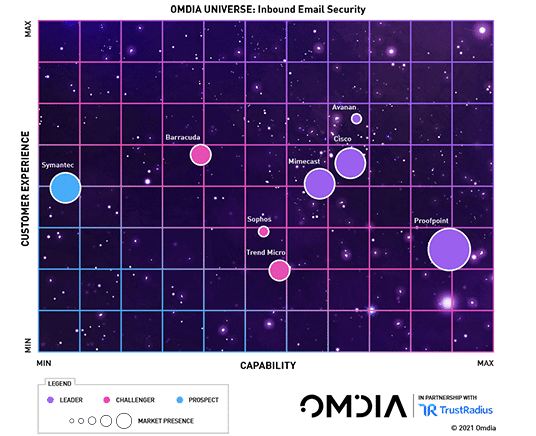
Gartner’s Market Guide for Email Security Platforms and Omdia’s guide to selecting an email security platform both cover this API-based approach in more detail.
Explore the advantages of API-based email security solutions in this report by Gartner. Then, learn about how to select an email security solution.
Selecting the Right Email Security Vendor
A Email Security solution must include certain key features to provide effective protection to an organization.
Here is a summary of the main points:
| Criterion | Check Point | Microsoft (EOP / Defender) | Proofpoint Essentials | Mimecast M2 |
|---|---|---|---|---|
| Deployment | No MX record change required | No MX record change required | MX change required; address becomes public | MX change required; address becomes public |
| Phishing / social engineering | Best catch rate; API-native detection | Evadable; advanced protection is Plan 2-only | Misses some phishing evasion attacks | Basic anomaly detection; limited coverage |
| Zero-day protection | Full sandbox + CDR, industry-leading catch rate | Sandbox misses advanced evasion; no CDR | No CDR; sandbox is a separate paid add-on | Has CDR but misses advanced detection |
| Data loss prevention | Full-suite DLP + encryption for Microsoft 365 | Partial DLP on E3; full DLP on Plan 2 only | Sometimes blocks legitimate email on keyword match | DLP data types must be defined manually |
| Collaboration apps | Real-time coverage for Slack, Teams, file-sharing apps | Limited; no Slack/Citrix coverage | Requires a separate CASB, added cost | Archiving only, no real-time coverage |

Global Chemical Manufacturer Grace Secures Cloud Digital Transformation with Check Point Email Security Solutions
“Grace has deployed Office 365 cloud based email solution…. We were experiencing significant phishing attacks; within three months we were in trouble. We turned to our trusted partner Check Point and deployed Workspace Security Email & Office. Within an hour we had the product up and running. Within the second hour we had it properly tuned and it was catching emails immediately…”
– David Antlitz, Global Manager, Security and Firewall Technologies, Grace

Gimv secures critical investment data with Check Point Email Security
“We exchange a lot of sensitive data, through a lot of emails…. Data security is critical. It’s not a question of ‘if’ you’re being attacked, it’s ‘when’… We had another provider, but Check Point was the first to introduce a threat emulation feature... It’s a ‘set and forget’ solution, it gives end users the confidence to know that the mail in their mailbox has already passed security checks and is secure”
– Kristof Poppe, IT Manager, Gimv

Canal Bank Secures Email with Check Point Email & Office
Cloud technology plays an important role in Canal Bank’s strategy… Canal Bank chose Workspace Security Email & Office, a cloud service that is built specifically to fight cloud email and productivity suite threats… “We have been using Workspace Security Email & Office for the last year, and during that time we have stopped approximately 1400 phishing attacks”… “The solution also defended us from about 800 malware attacks… Check Point also provides reports that give me thorough visibility into threats targeting our email platform.”
Additional Resources
Videos
Workspace Security Email & Office Identity Protection
Grace Secures Over 5000 Mailboxes with Workspace Security Email & Office
Gimv protects Office 365 with Workspace Security Email & Office
The right choice depends on deployment model. API-based platforms like Check Point Workspace Security Email protect Microsoft 365 and Google Workspace without rerouting mail through a gateway, while traditional secure email gateways like Proofpoint and Mimecast require an MX record change.
API-based email security integrates directly with Microsoft 365 or Google Workspace, so it does not require changing MX records, does not expose which vendor you use, and covers internal email traffic that gateways cannot see.
Some platforms do. Check Point Workspace Security Email extends real-time protection to Slack, Teams, and file-sharing apps from the same console; Proofpoint and Mimecast typically require a separate CASB product for this coverage.
In Check Point’s own testing, its API-based email security caught 44x more phishing emails than legacy gateway vendors including Proofpoint, Mimecast, and Barracuda, and 93x more than Microsoft’s built-in protection.


