Infographic | From GPUs to Guardrails
Discover how to secure AI from infrastructure to usage with a unified AI security architecture. Learn how to protect AI workloads, agents, applications, data, and users while reducing risk across the entire AI lifecycle.
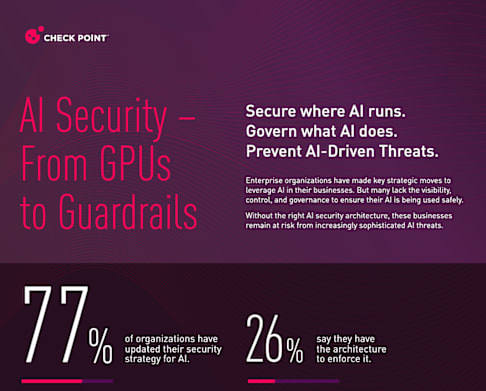
AI Security – From GPUs to Guardrails
Secure where AI runs. Govern what AI does. Prevent AI-Driven Threats.
Enterprise organizations have made key strategic moves to leverage AI in their businesses. But many lack the visibility, control, and governance to ensure their AI is being used safely.
Without the right AI security architecture, these businesses remain at risk from increasingly sophisticated AI threats.
77% of organizations have updated their security strategy for AI. 26% say they have
the architecture to enforce it.
The disconnect between AI adoption velocity and real AI security preparedness is one of the biggest challenges facing security leaders – left unchecked, this gap will only widen.
70% 64% 83% 5%
of organizations run GenAI workloads in production
have deployed AI agents in live environments
say securing GenAI workloads is harder than securing traditional applications
*2026 Cloud Security Report & 2026 AI Security Gap Report
report full visibility into AI tools and services used across the organization
The AI Security Stack Employee AI Use & Shadow AI
Risk
Only 5% of organizations report full visibility into which AI tools employees are using, what data those tools access, and where that data goes once it enters an AI workflow.
Make every employee AI interaction visible and governed
Classified
Discovered Allowed
Check Point secures
Workforce AI Security discovers and monitors sanctioned and shadow GenAI applications, assesses user intent, enforces policy, protects sensitive data, and provides GenAI activity breakdowns at the application, session, and user level.
Audited
Employees are already using AI. Check Point helps security teams see where, why, and how data is moving through GenAI tools.Blocked
Source: 2026 Cloud Security Report: https://www.checkpoint.com/lp/security-report-2026-form-gsem?
AI Applications & APIs
Inspect prompts, model calls, and outputs
Prompt Defense
GPT-5.6
API Security
Private LLM
Output Control
Enterprise AI App
Risk
GenAI applications introduce long prompts, streaming responses, model-specific APIs, and service-to-service interactions that do not fit neatly into traditional application security assumptions.
Prompt: AI Security Gateway
For private LLMs and GenAI apps, Check Point inspects the prompt, protects the API, and governs the response.
Check Point secures
Check Point WAF and AI Security protect LLM APIs from prompt injection and jailbreak attacks, enforce safe and compliant use of LLMs through policy controls, monitor and restrict LLM tool and function usage, and help prevent sensitive data leakage in LLM responses.
Runtime Guardrails for LLMs & Agents
Risk
Runtime controls still lag behind deployment. Our 2026 Cloud Security Report found that 83% of organizations are still in earlier stages of runtime LLM control maturity. Just 11% reported broad deployment and 6% reported enterprise- standard deployment.
Control AI behavior in real time
Prompt
Data
Output
Action
Policy Guardrails cannot be static. They need to inspect AI inputs, outputs, actions, and behavior as they happen.
Check Point secures
Check Point AI Agent Security provides real-time visibility and control over GenAI applications by intercepting both prompts and generated outputs from the LLM, with customizable guardrails that include prompt defenses, data leakage prevention, content moderation, malicious link detection, and policy-driven filters.
Data Exposure & Prompt Risk
Avoid the risk of sensitive data being leaked
1 in 41 prompts high risk
Risk
Our research found that high-risk GenAI prompts doubled over the past year, and the average organization now runs ten AI applications a month, many outside formal approval processes.
Additionally, organizations interact with more than fourteen different AI services per organization on average, approximately 89% of organizations were impacted by risky prompts within an average month, and 1 in 41 submitted prompts were classified as high risk.
The AI leak path is often the prompt itself. Check Point helps detect risky prompts, classify sensitive data, and stop exposure in real time.
Check Point secures
GenAI Protect provides unified visibility into sanctioned and unsanctioned AI usage, inline policies to prevent sensitive data exposure through real-time AI-based classification, granular controls, full inspection and data lineage, and integration with enterprise DLP and threat prevention systems.
Autonomous Agents & Intent-Aware Security
Risk
AI agents can access data, trigger actions, use APIs, and operate autonomously, expanding the security challenge from monitoring user inputs to controlling machine-driven decisions.
Secure what AI is trying to do
As AI moves from generating answers to taking action, security must understand intent, context, policy, and behavior.
Intent, Context, Action, Policy, Audit
Intent-aware
Check Point secures
Our AI Defense Plane includes Workforce AI Security for employee AI usage, AI Agent Security for runtime visibility and protection of AI applications and autonomous agents, and AI Red Teaming for adversarial and risk-based threat assessments.
GPU Infrastructure & AI Data Centers
Protect the AI factory foundation
Risk
AI infrastructure concentrates sensitive datasets, proprietary model weights, distributed inference services, and high- throughput GPU fabrics, expanding the attack surface beyond what legacy architectures were designed to address.
Check Point protection
AI Factory / GPU Fabric / Private LLM Core
From GPU clusters to private LLMs, AI infrastructure needs security designed into the stack, not added after deployment.
Check Point secures
GPU-powered AI factories, private LLM environments, distributed inference workloads, Kubernetes-based AI environments, east-west traffic, and autonomous AI agent interactions through a layered AI security architecture.
Hardware-Accelerated AI Security
Risk
AI factories require inline, infrastructure-level security that can operate at hyperscale speeds while maintaining visibility into complex AI interactions.
Bring enforcement closer to the workload
BlueField DPU + DOCA Argus Integration.
Check Point secures
Check Point customers can use AI Factory Firewall integration with NVIDIA BlueField DPUs and NVIDIA DOCA Argus architecture for defense- in-depth protections across private LLMs, distributed inference workloads, Kubernetes- based AI environments, east-west traffic, and autonomous agent interactions without impacting GPU performance.
Security moves into the AI data path, protecting high- performance infrastructure without slowing innovation.
Workloads, Kubernetes & East-West Traffic
Stop lateral movement across AI environments
RiskRisk
AI environments rely on Kubernetes orchestration, high- speed interconnects, distributed training frameworks, and API-driven interaction at scale, creating new exposure points across the infrastructure.
AI environments rely on Kubernetes orchestration, high- speed interconnects, distributed training frameworks, and API-driven interaction at scale, creating new exposure points across the infrastructure.
Check Point securesCheck Point secures
AI workloads move fast. Security has to see and control traffic between models, services, containers, and clusters.
Check Point AI Factory Firewall protects Kubernetes-based AI environments and east-west traffic across AI infrastructure. Check Point AI Factory Firewall protects Kubernetes-based AI environments and east-west traffic across AI infrastructure.
One Architecture for the Full AI Stack
From GPUs to guardrails, Check Point secures your end-to-end AI transformation. Learn more →
AI Security Solutions - Check Point Software
Worldwide Headquarters 5 Shlomo Kaplan Street, Tel Aviv 6789159, Israel | Tel: +972-3-753-4599
U.S. Headquarters 100 Oracle Parkway, Suite 800, Redwood City, CA 94065 | Tel: 1-800-429-4391
www.checkpoint.com
https://www.checkpoint.com/ai-security/